

AI Threats in 2026: What Are the Real Dangers and How to Respond?

What are AI threats? In most cases, the immediate risks are less like Hollywood science fiction and more like everyday problems that we already deal with. The danger of AI arises when people use artificial intelligence to make deception and cybercrime more convincing, targeted, or easier to scale. These can range from phishing messages targeting specific victims to fabricated content designed to manipulate public perception of a brand or person. The most common goals are to get someone to reveal information, send money, believe something false, or ruin a reputation.
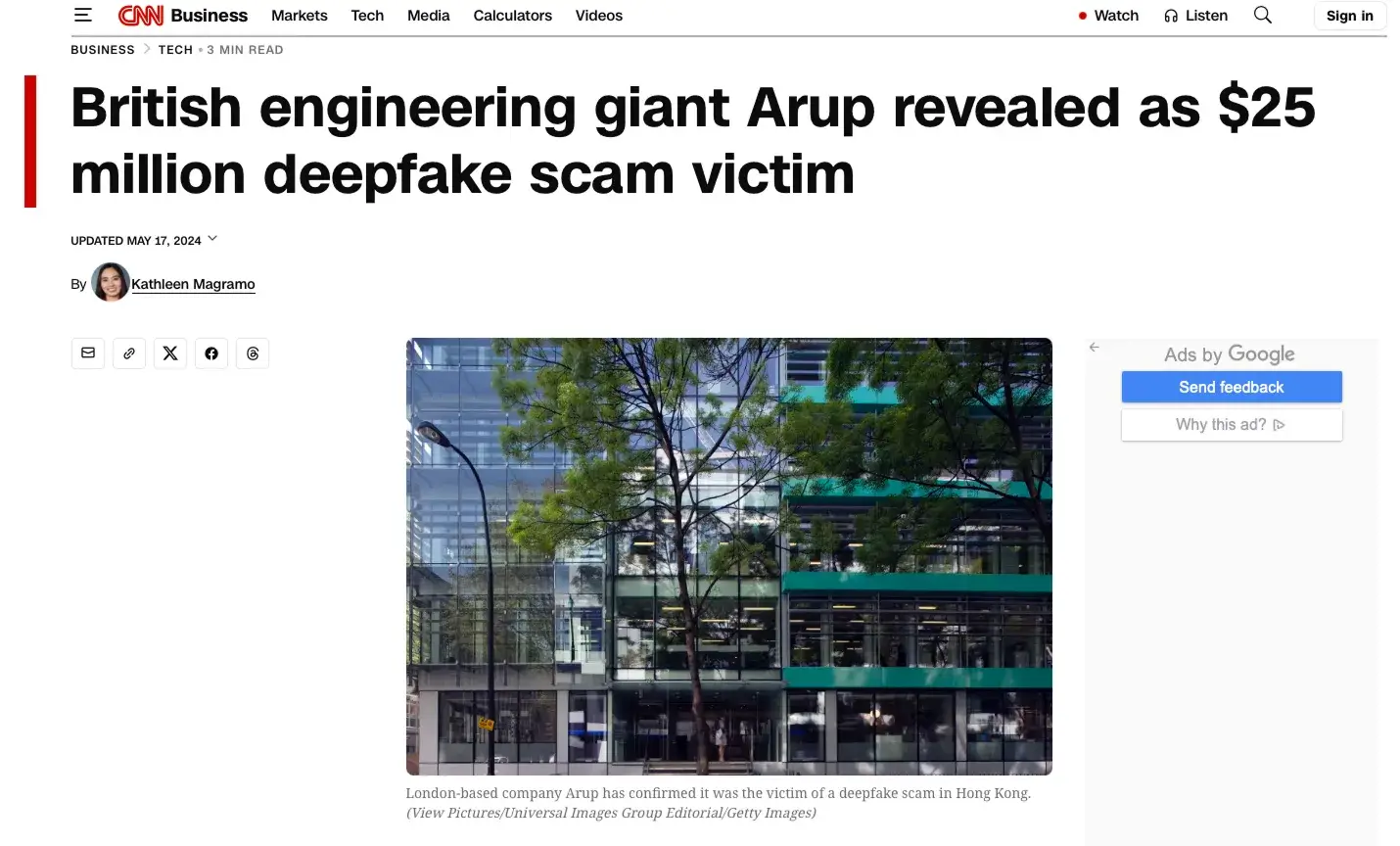
For example, in 2024, a finance employee at engineering firm Arup’s Hong Kong office transferred $25 million to cybercriminals after joining a video call with deepfake recreations of the company’s CFO and other colleagues.
That’s the reality of AI threats in 2026: attackers do not need breakthrough tactics when familiar scams become much harder to recognize and easier to scale. In this article, we’re taking a look at the main risks, who is most exposed, and what individuals and organizations can do to minimize the risks.
What are AI threats?
AI security threats are risks that arise when people use artificial intelligence to deceive others, exploit digital systems, manipulate public perception, or endanger privacy.
Every major technological leap brings new challenges for protecting information and assets from misuse. Fun historical fact: in 1834, what is widely considered the world’s first cyberattack was committed by two Frenchmen, who hacked the national optical telegraph system. They bribed an operator to insert false signals into the state-run Chappe optical telegraph at Tours to hide market signals within official dispatches. This let them learn Paris bond price movements before anyone else and trade on that information.

Today, the sheer power and capabilities of AI make familiar attacks faster, more tailored, and easier to repeat. Generative AI models can help scammers write flawless phishing messages, imitate the voice of a trusted human, and create misleading reports at scale.
Key highlights
- AI threats are familiar security risks amplified by new tools.
- Motives remain largely the same: money, information access, and public influence.
- Malicious automation is the core issue businesses face today.
The biggest AI threats in 2026
From simple automated bots just a few years ago, the landscape of AI cyber threats has shifted to hyper-personalized attacks executed at a massive scale. Let’s look at the most significant AI dangers and risks targeting businesses and individuals today.
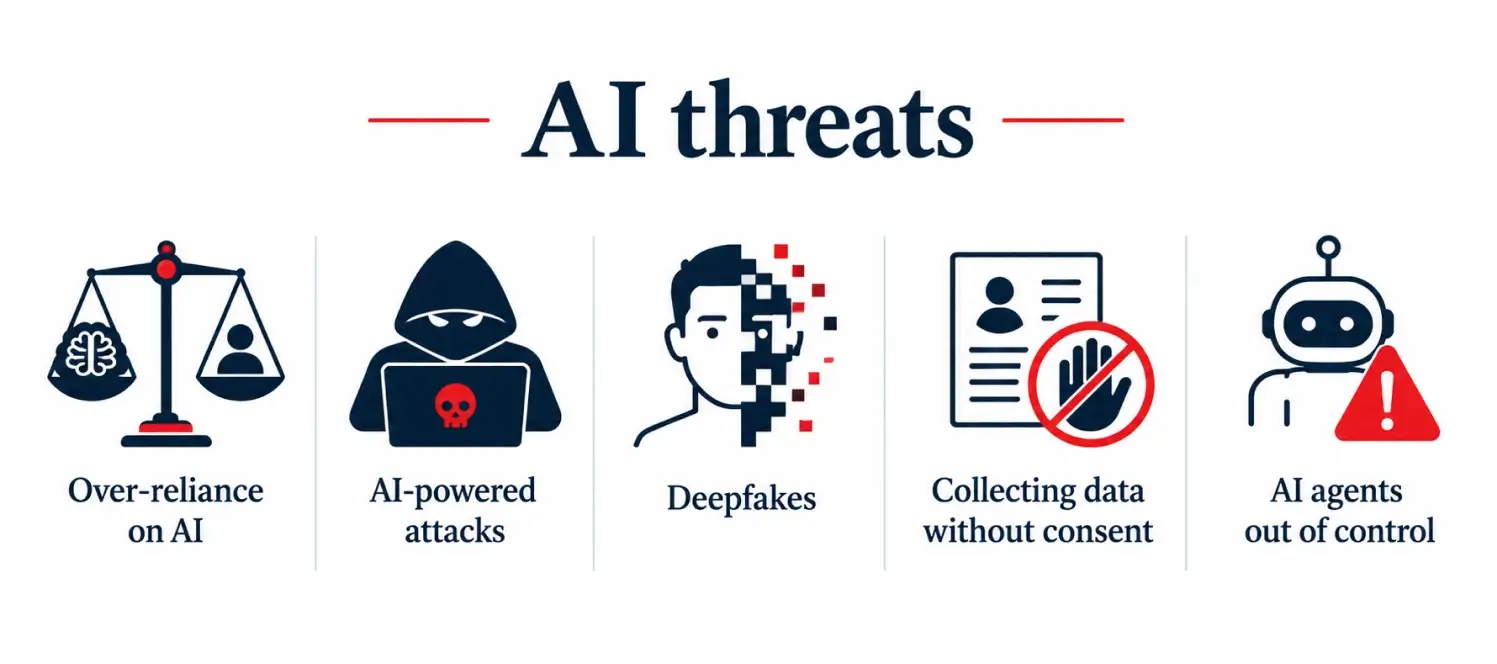
One of the biggest dangers of AI doesn’t even stem from malicious intentions. An employer researching prospective hires or a business conducting due diligence on partners often relies heavily on information generated by an AI system. However, this output is simply a reprocessing of data already available online. Sometimes, the model paints a picture of a person or company that is far from accurate.
We have seen many cases, in which competitors deliberately spread negative information about a client’s company across various forums and review sites. The AI models simply scraped and summarized this newly created false consensus. This often led to deals going down, prospects turning to competitors, among other consequences.
To solve it, we first addressed and removed the negative content at the source. Then we worked on updating the AI-generated results and information based on the corrected online footprint. It is rarely possible to fix the AI output without fixing the source web data first.
AI-powered cyberattacks (targeting AI as well)
Artificial intelligence can significantly increase the efficiency of almost any cyberattack. Hackers use it to research vulnerabilities, analyze publicly exposed systems, modify malicious code, and deploy targeted phishing campaigns.
In May 2026, Google Threat Intelligence Group reported identifying a criminal actor planning a mass-exploitation campaign using a zero-day exploit the group believed had been developed with AI. The research concluded that its intervention may have prevented the exploit from being used. This is one example of how AI can assist vulnerability research and exploit development, potentially helping attackers breach an organization’s security.
Attacks on AI systems are also on the rise. Data poisoning involves manipulating data used to train a model so it learns misleading patterns. For example, if an attacker could influence the training data for a fraud-detection system, the model might become less likely to flag certain suspicious transactions. That could weaken the model’s fraud-detection decisions. This is why organizations need to ensure the safety of both their networks and the data and processes used to build and update their AI systems.
Deepfakes and scams
AI has made reputation management significantly more complex. Deepfakes and voice cloning are fueling massive corporate scams and personal defamation. AI-generated audio, video, and documents can easily be presented as genuine evidence, making it harder for humans to know what to trust.
In March 2025, scammers used deepfake technology to impersonate senior executives during a Zoom call. They persuaded a finance director at a multinational to transfer more than US$499,000 to a scammer-controlled account as part of a supposed confidential restructuring. When the scammers asked for another US$1.4 million, the director alerted the bank. Singapore and Hong Kong police traced and recovered the transferred funds.
If you’re targeted by a deepfake or voice-cloning scam, act quickly to preserve the evidence. Save the original file where possible, record the link and account details, and keep relevant messages and timestamps.
At Reputation America, we use AI-detection tools alongside available metadata, reverse image searches, and other forensic checks to assess whether content may have been manipulated. These methods can help build an evidence-based assessment, but no single detector or clue should be treated as conclusive.
Fun fact: while this is not a guaranteed detection method, watch out for voices that sound too clean. The absence of natural human imperfections, like subtle background breaths or slight mid-sentence hesitations, is a possible sign of an AI voice clone, which can be generated from just a few seconds of audio easily obtained from a public social media video.
When AI knows too much about you
Artificial intelligence collects, links, and analyzes massive amounts of data far more efficiently than humans can. AI-powered services and data brokers can combine details from public posts, websites, and commercial datasets. When connected, this data reveals far more than any single record could on its own.
In 2024, the Dutch Data Protection Authority fined facial-recognition company Clearview AI €30.5 million after finding that it had scraped billions of facial images from the internet, including those of Dutch residents, and converted them into biometric identifiers without people’s knowledge or consent.
Reducing exposure starts with an audit:
- Review public social profiles, online CVs and resumes, search results, and data broker listings.
- Tighten privacy settings, remove unnecessary information, and use opt-out or deletion processes where available.
- Be mindful of what you share with AI apps: depending on the service and its settings, conversations may be stored or viewed by third parties.
- Review relevant sources in each language and market where a person or company is active. An English-language search alone may miss information elsewhere.
AI agents acting without human control
Modern AI systems do more than answer questions; they can execute multi-step tasks across emails, websites, and code repositories. However, a model given an unclear goal might misread context or misuse its access, causing unintended harm.
For example, a marketing AI agent told to “increase website traffic” might prioritize clicks over quality. If it has permission to contact customers or publish content, it could send too many messages or post unverified claims. Depending on the level of access and safeguards, that could lead to customer complaints, compliance problems, lowered email deliverability, and, in some cases, cause a domain to be blacklisted.
Before giving an AI system access to external communications or financial transactions, define its operational scope carefully. Use least-privilege access, test in a sandbox, set spending and volume limits, and require human approval for high-impact actions. Human oversight matters most when actions are hard to reverse or affect customers, money, or sensitive data.
Highlights:
- Fix the source: correcting source material is often an important first step in correcting false AI narratives.
- Data poisoning: attackers may manipulate training or update data to create blind spots in AI systems.
- Forensic defense: dealing with deepfakes requires swift action and documenting evidence, which can then be submitted to platforms and authorities.
- Digital footprint reduction: avoiding publication of unnecessary public data can limit AI profiling.
- Human oversight: autonomous AI agents require strict guardrails to prevent severe PR and legal implications.
Can AI become a threat to humans?
While anything is possible in the long term, what are the real dangers? Most present-day threats do not depend on machines becoming conscious. AI can harm people in less sensational but practical ways: producing convincing false claims, exposing personal privacy, automating biased decisions, or taking actions that humans fail to review.
The risks depend not only on what AI can do, but on how much authority people give it. Over-reliance on AI can lead to a single point of failure. If a model screens candidates, approves transactions, or provides public-facing information without independent review, an error can easily spread unnoticed until it is too late.
Key takeaways:
- Existential threats are far less urgent than immediate reputational and infrastructural vulnerabilities.
- AI hallucinations can destroy a reputation if taken as fact by employers or clients.
- Over-reliance on automated systems creates single points of failure for organizations.
How to protect yourself and your business from AI threats
Understanding the risks is only the first step. Effective protection combines solid security basics, clear verification procedures, careful use of automated systems, and human oversight.
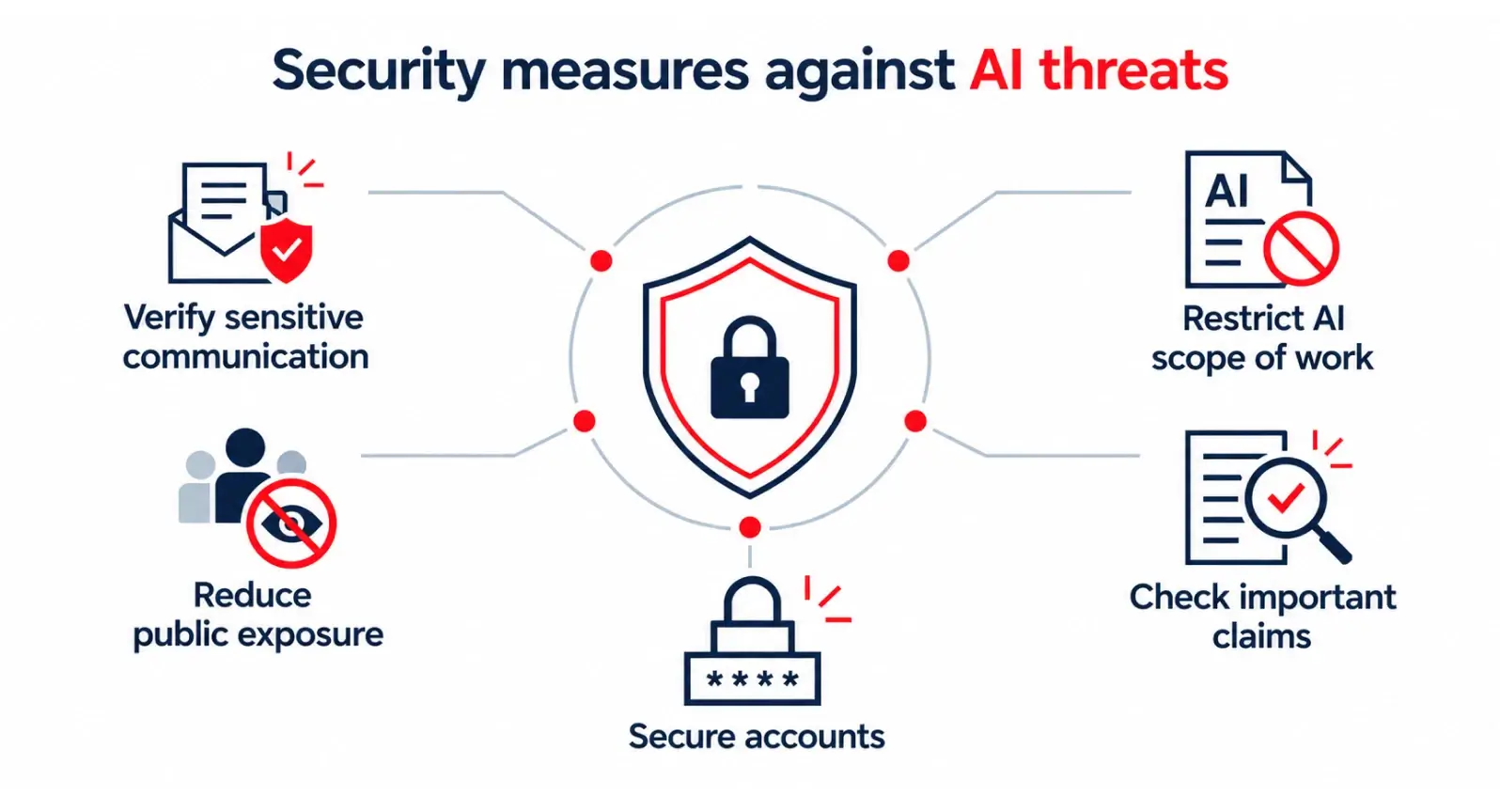
- Verify sensitive requests independently. Use a known phone number or a separate channel before approving significant payments or other corporate actions.
- Secure accounts and systems. Use phishing-resistant MFA, keep software up to date, limit access, and maintain backups.
- Restrict AI tools and agents. Use approved services, ensure confidential data safety, and require human approval before taking significant action in live systems.
- Reduce public exposure. Review public profiles and data-broker listings; tighten privacy settings and request removals where possible.
- Check important claims. Verify AI outputs against reliable sources.
Ironically, the best defense against malicious AI is often defensive AI. For example, at Reputation America, we use AI to flag emerging narratives, group recurring claims, and review accessible public sources. But since a model can miss context or repeat inaccurate information, our analysts verify the sources before recommending action.
FAQ
AI threats involve the malicious use of artificial intelligence to automate cyberattacks, generate hyper-realistic deepfakes, and exploit personal data. Rather than sci-fi scenarios, these threats are practical and immediate. Bad actors use machine learning to manipulate public perception and map digital vulnerabilities at speeds impossible for human teams to match.
The primary threats center on high-speed automation and evidence falsification. This includes polymorphic malware that actively rewrites its code to evade traditional antivirus software. We are also seeing a massive rise in hyper-personalized phishing campaigns and data poisoning, where hackers introduce deliberate errors into a company's internal machine learning models.
Malicious actors use AI to flood review platforms with convincing, fake negative feedback to destroy brand trust overnight. They also clone executive voices for financial scams and aggregate public data to create damaging corporate narratives. Because AI models learn from these manipulated sources, a localized smear campaign can quickly become the default AI-generated summary of your business.
The technological capabilities of AI are not overhyped, as they profoundly alter how digital systems operate. However, the expectation that AI is a flawless, "plug-and-play" solution is severely misguided. Businesses rushing to deploy AI tools without proper guardrails often face massive data leaks and PR crises. To function safely, AI requires rigorous human-in-the-loop oversight and strict data governance.
When evaluating AI through the lens of digital security, the top five disadvantages center on data exploitation and automation risks. AI aggressively erodes privacy by compiling sensitive dossiers, democratizes evidence falsification through deepfakes, and frequently generates biased or hallucinated narratives. Additionally, it introduces security blind spots through training data poisoning. Finally, autonomous agents operating without human oversight risk executing misaligned actions that trigger domain blacklisting.
List of sources
- CNN, British engineering giant Arup revealed as $25 million deepfake scam victim
- Hard2bit, The first cyberattack in history happened in 1834
- Google Cloud blog, GTIG AI Threat Tracker: Adversaries Leverage AI for Vulnerability Exploitation, Augmented Operations, and Initial Access
- Tookitaki, The CEO Wasn’t Real: Inside Singapore’s $499K Deepfake Video Scam







This article does not have any comments. Be first to leave one.