

Reputation Management Services: What They Are and How They Work
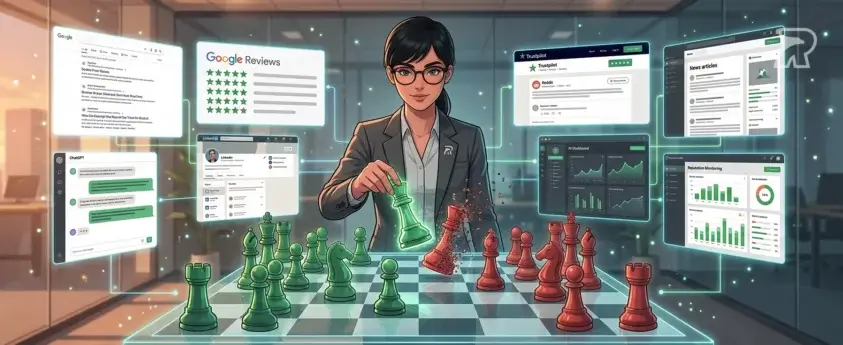
Reputation management services help individuals and businesses control what people see in Google, reviews, social media, news, and AI-generated results. From my personal experience as a small business owner, I know how unsettling it is to Google your own name and find a negative review or damaging article on page one. This guide explains how online reputation management works, what shapes your digital image, which problems can be fixed, and when professional help may be needed.
For example, 74% of consumers will not move forward with a purchase if they see negative content on the first page of Google. From this guide, you’ll learn what online reputation management services are, which steps you can take on your own, and how Reputation America can help in your particular case.
What Are Reputation Management Services?
Online reputation management (ORM, often abbreviated as online reputation mgmt) is the process of protecting your personal or company reputation and monitoring how it is perceived on the internet. Today, with the speed at which information spreads, web reputation management is essential because media platforms and search engines, like Google, Microsoft Bing, DuckDuckGo, or Yahoo, can ruin reputations within hours. ORM attempts to take charge of such narratives and make your online reputation reveal only the good aspects of your image or brand.
Spotlight
A short historical note. Reputation management did not start with the internet. In the 18th century, the printer John Peter Zenger was prosecuted for libel for publishing criticism of the governor. His lawyer won the case by arguing that the truth of a statement is a defense, a principle that still anchors U.S. defamation law today.
In our modern times, online reputation management practices encompass monitoring and influencing the perception of a brand or individual by the target audience on the internet. ORM is a mix of practices of the proactive management of social media mentions, reviews, search results, and online media. All aimed at shaping a positive public image.
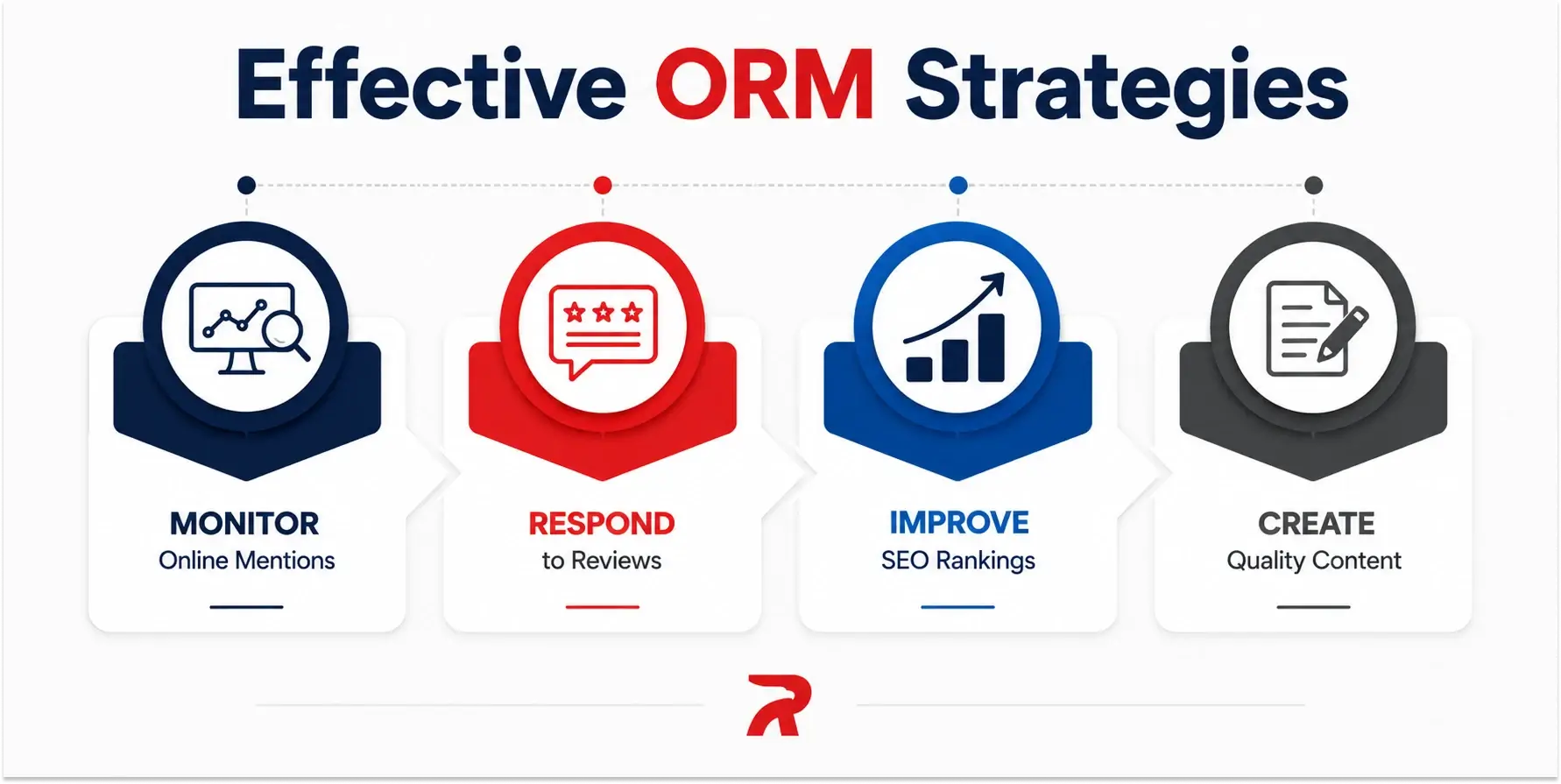
Effective ORM strategies include activities in four categories:
- Monitoring Online Mentions: This is mainly done for data collection and analysis. One has to track search results, major review sites, social media, AI answer engines, data brokers, and news to understand how people perceive the brand. For example, a company can identify through monitoring an outdated profile page on an investment platform, which results in misrepresentation in search results.
- Responding to Reviews: This strategy involves working with customers, their negative reviews, by contacting them and offering solutions. In one case, a hotel chain responded professionally to a guest’s complaint about room cleanliness and offered a sincere resolution, prompting the customer to update their review to four stars.
- Improving SEO: This includes a set of techniques to manage the ranking of content in engines’ search results. The goal is to make sure that good content is on the first page of search results, and bad information is pushed down.
- Content Creation: To outweigh the unwanted information, it is also necessary to develop high-quality, informative content that portrays the brand positively and deserves to rank higher than ‘bad’ one. For example, a healthcare practitioner may publish education articles on their area of expertise, which gradually rank higher than older mentions.
With active reputation management, you reduce the impact of unfavorable content. If you have to address bad reviews, false news stories, or hate speech, online rep management is all about restoring your good online reputation.
Pros of online reputation management
- Defuses unmanaged conflicts, online negativity, and digital hate.
- Provides tools necessary to control your online appearnce.
Cons
- Requires professional expertise to execute legally.
- Cannot completely erase past public records without proper authority.
Why online reputation management matters in 2026
Your reputation is your revenue. In 2026, three shifts make reputation management services critical:
- AI Overviews answer first. Google’s AI and ChatGPT cite reviews and news directly — often pulling outdated content. 66% of people trust AI-generated content without verifying its accuracy.
- Reviews drive decisions. One negative first-page result cuts conversion rates by 41%.
- Hiring. A poor rating of a company increases hiring costs, while the majority of recruiters Google candidates before interviews.
Key takeaways
- Audit your name monthly on Google, Bing, and AI tools.
- Don’t assume “no news is good news” as silence allows negative to prevail if it appears.
What shapes your online reputation
AI systems, search engine visibility, and customer review platforms all contribute to one’s online reputation. Positive content displays on the first page of search results, pushing negative stuff down. Modern AI chatbots like ChatGPT and Google AI can impact your image if their underlying training data contains negative information. At the same time, securing first-page rankings on Google Search is critical for driving immediate public perception. Furthermore, review sites such as Yelp, Trustpilot, and Google Business Profile act as essential trust signals, where falling below a 4.0 score can actively deter potential conversions.

Common online reputation problems
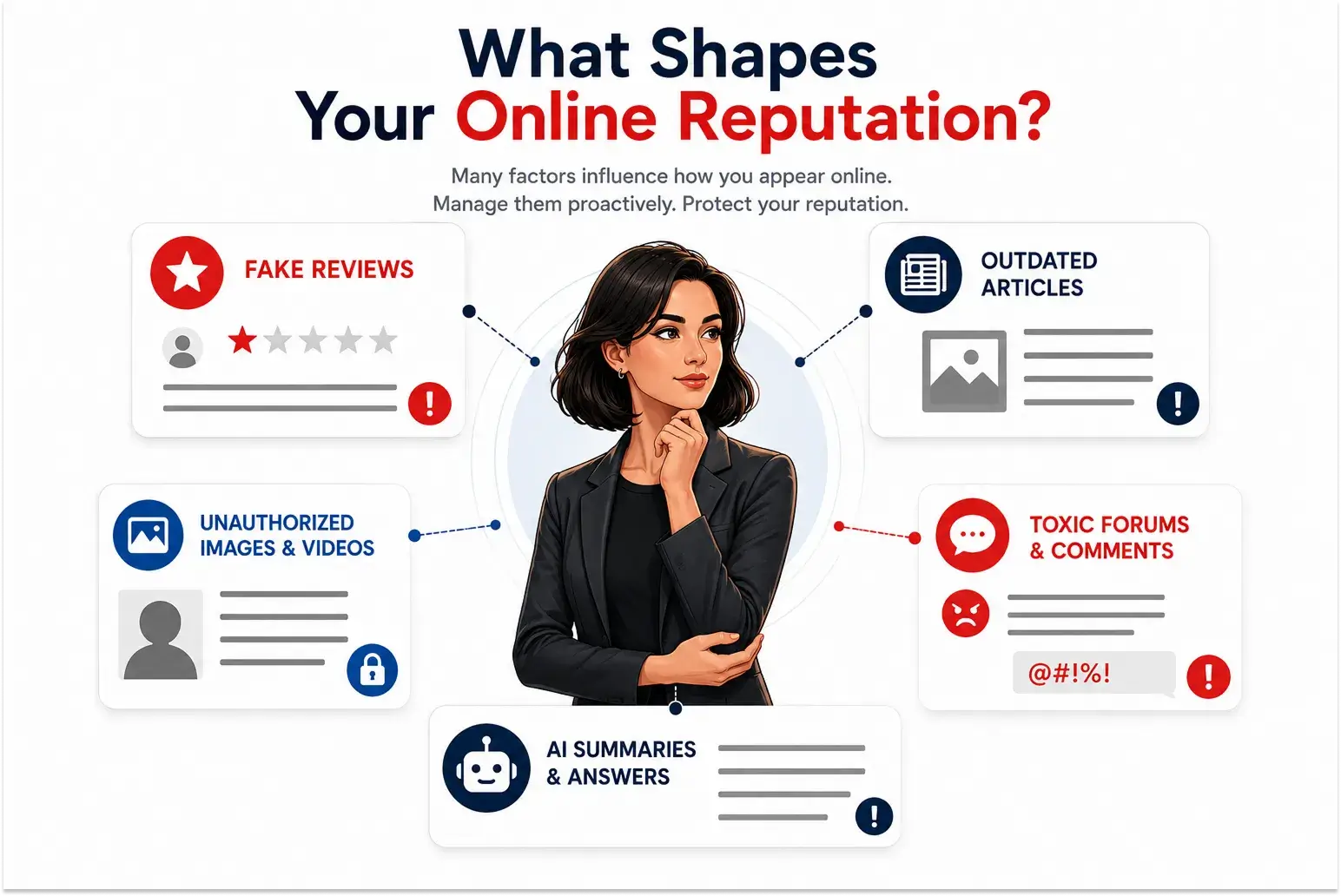
Recognizing the type of problem is the first step for any online reputation manager trying to come up with a successful solution.
- Negative and fake reviews. Coordinated 1-star campaigns on Yelp or Google Business, often bought by competitors, can severely damage a brand.
- Defamatory and outdated articles. Old regional news reports about dropped charges or blog posts remaining visible.
- Unconsented imagery & video. Leaked, copyrighted, or non-consensual personal photos and videos.
- Toxic forum threads. Hostile posts on Ripoff ReportReddit, and others rank highly.
- AI summaries. Can surface outdated, inaccurate, or misleading information by relying on historical sources.
Spotlight
Fun fact: In China, writing hostile comments is risky because real-name registration laws let platforms like WeChat share data with authorities. The US protects anonymous speech more, which is why removal requires legal proof, not just a request.
Pros
- Most content is removable under US law or site’s TOS.
- Identifying the source speeds up removal.
- Positive reviews build immediate buyer confidence.
Cons
- Fake reviews can spread rapidly if not monitored.
- Defamatory articles can stay indexed indefinitely without active intervention.
Online Reputation Challenges
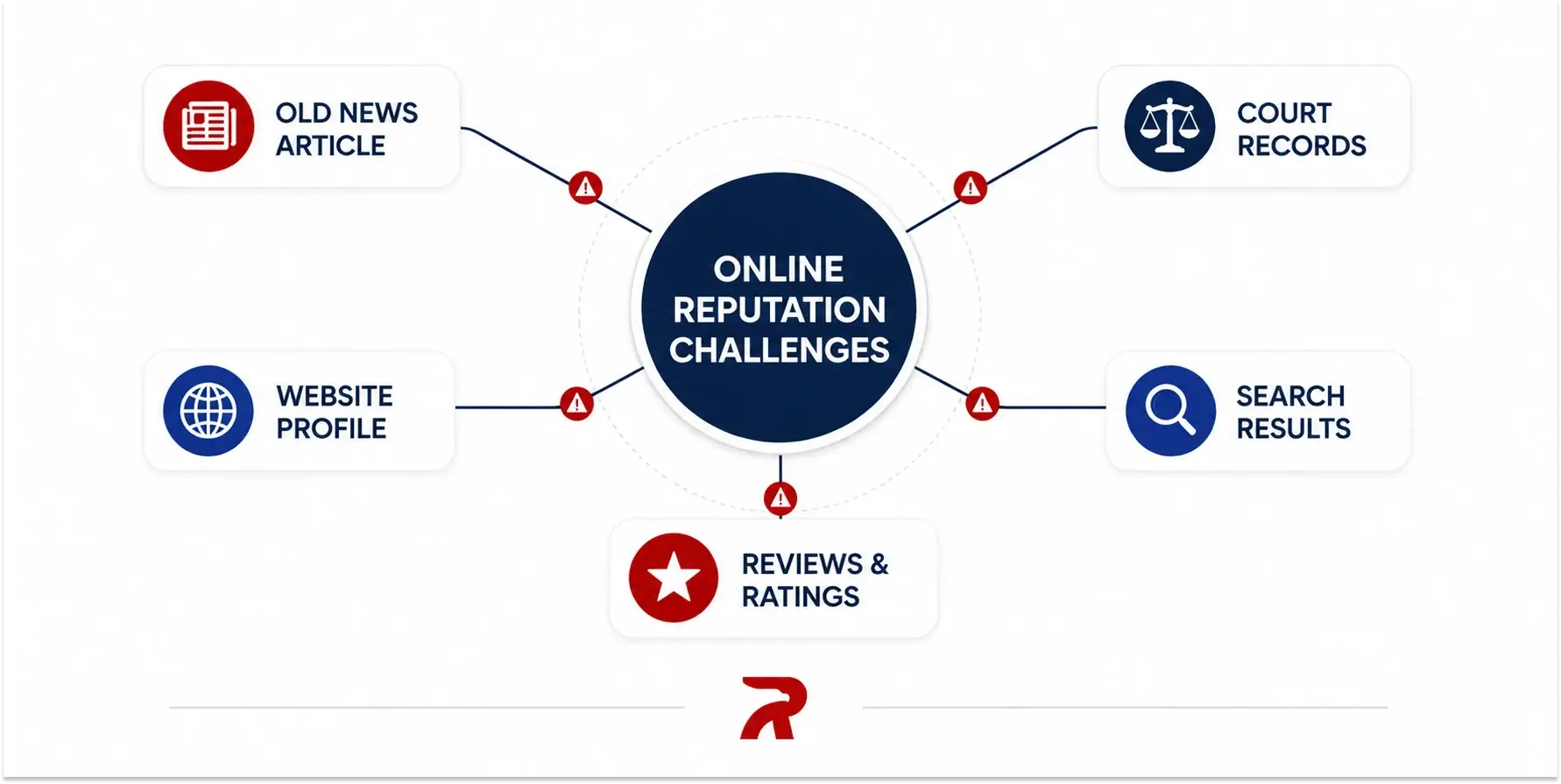
Online reputation management often involves addressing a variety of content-related issues that can affect individuals or organizations. Some solutions require dealing with multiple types of content on various platforms at once.

Many people assume reputation management is about dealing with a single article, but in practice the situation is often much more complex. In one case, we worked with a client whose online presence was affected not only by a widely circulated news story, but also CNN coverage from 15 years ago and public court records. There was a specific approach for each type of content. We removed information from a website regarding the client’s participation in an educational forum, as the details were no longer relevant following a change in her career path. Finally, we worked on removing court records that mentioned the client as a plaintiff.
Elizabeth
Chief Product Officer
Contracts and Safeguards
Before we start the work, we formalize the project with two key documents:
-
Statement of Work (SoW):
This document defines the exact content we will work on, including links, screenshots, deadlines, pricing, and agreed performance indicators. -
Service Agreement:
This agreement sets the general terms of cooperation, including confidentiality, escalation rules, guarantees, and mutual responsibilities.
Pros of Working With an ORM Agency
- Experience dealing with policies and legal processes.
- Structured workflows and documentation.
- Coordination across multiple content sources and search results.
Cons
- Can be more expensive than DIY.
- Less direct day-to-day control.
- Results vary depending on the platform, content type, and legal context.
Mistakes to avoid when managing your online reputation
Many individuals and businesses worsen their reputation crises by reacting emotionally or utilizing unethical shortcuts.
Spotlight
In my experience, a consulting firm was mentioned in a critical article. The executive appointed to manage the crisis authorized the purchases of fake positive reviews and comments to “balance out” the negative coverage. When these reviews were removed, she also publicly argued with critics on social media, which triggered widespread discussion. As a result, the fake review scheme resulted in a civil penalty from the FTC, while the original ‘bad’ article gained even more visibility.
When choosing and contacting an online rep management company, avoid these common traps:
- Paying 100% upfront: reputable agencies bill on milestones only.
- Buying fake reviews: this is a federal crime under the FTC’s Consumer Reviews and Testimonials Rule, carrying significant civil penalties as high as $51,000 for each violation.
- Publicly arguing: direct public arguments trigger the Streisand effect, drawing massive search traffic to the negativity.
- Ignoring the problem: negatives compound, acquire backlinks, and train AI models. Doing nothing is not a solution.
If negative content is already visible in search results, our internet content removal services can help remove or reduce harmful online materials.
FAQ
ORM can benefit your business by actively managing how your brand is perceived online. By addressing negative reviews and promoting positive content, ORM helps to build a trustworthy image necessary for increased customer loyalty and sales. Additionally, a strong online reputation helps with search engine ranking.
A successful online reputation cleanup can deliver more than improved search results. Depending on the circumstances, clients have used their restored online presence to secure career and business opportunities, expand their companies, attract new customers, and recruit high-quality talent, helping remove barriers that bad online content may have created.
The online reputation management timeframe varies depending on the nature of the content, the platforms involved, and the complexity of the case. Certain concerns can be resolved in a few weeks, whereas others may take several months. Important factors include content age, number of sources, and whether legal, editorial, or review processes are required.
Reputable online reputation management practices are based on lawful approaches, such as requesting the removal of inaccurate or outdated information, communicating with website owners and publishers, optimizing positive content, and using platform-provided reporting or appeal mechanisms. The specific methods depend on the circumstances and applicable laws and policies.
If reposting occurs the available options depend on where the content reappears, whether it violates site’s policies, and whether the original removal rationale still applies. Ongoing monitoring can help identify reappearances early and allow for a timely response when appropriate.
List of sources
- The Impact of Online Reviews on Consumers’ Purchasing Decisions: Evidence From an Eye-Tracking Study
- US Law Explained, Defamation, Slander, and Libel: The Ultimate Guide to Protecting Your Reputation
- Journal of Marketing Research, The Impact of Negative Reviews on Online Search and Purchase Decisions
- KPMG, Trust, attitudes and use of artificial intelligence: A global study 2025







This article does not have any comments. Be first to leave one.