

Copyright Violation: Step-by-Step Guide to Remove Stolen Content
A violation copyright happens when someone uses your original content without permission, and a DMCA takedown notice can help remove stolen content from websites, platforms, hosting providers, and search results. In my work, I regularly deal with cases where creators, businesses, and rights holders discover that their photos, articles, videos, music, or branded materials have been copied and used without authorization. This guide explains what a copyright violation means, when removal is possible, how to file a DMCA takedown notice, and what to do if the request is rejected.
Digital piracy costs the United States economy over $29 billion annually, and, obviously, it is independent creators and small businesses that suffer the most severe damages from copyright infringement. The good news is that the U.S. law provides tools to remove copyrighted content. In this article, we’re going to explore how a DMCA takedown notice works and how to file one in a few easy steps.
What Is a Violation Copyright?
An infringement of copyright takes place when an individual copies, disseminates, or exhibits a protected piece of work publicly without obtaining explicit authorization from the rights holder. In the U.S., there is no need to register your work to own it, although registration strengthens your legal standing in some cases. Anyone who copies, shares, sells, or publishes your content without your permission is infringing on your rights.
Types of content at risk
- Written documents. Blog posts, articles, website copy, whitepapers, eBooks, and marketing materials.
- Images and photography. Photos, illustrations, graphic designs, and even copyrighted AI-generated content.
- Videos. Commercials, educational course recordings, films, etc.
- Audio. Music, podcasts, voiceovers, and sound recordings.
- Software. Proprietary code, apps, plugins, and scripts.
Key highlights
- Copyrights of any type of content can be violated.
- Copyright protection is automatic and requires no registration once a work is created.
- Formal registration increases one’s ability to claim damages.
Copyright Infringement Examples
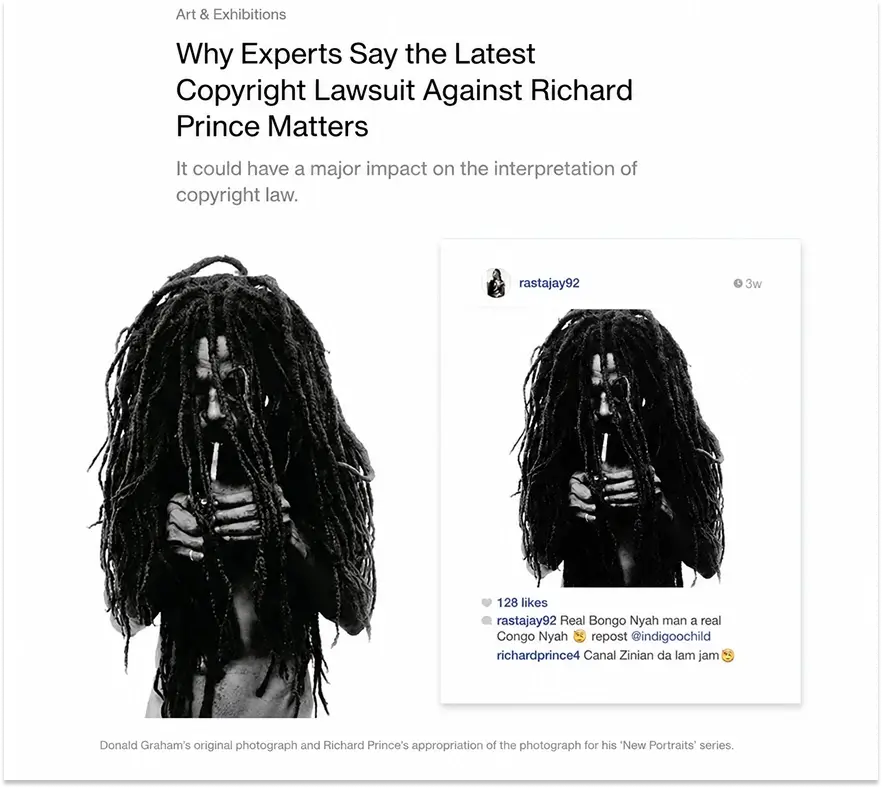
Richard Prince vs. Donald Graham
In this lawsuit, photographer Donald Graham sued artist Richard Prince for using his photo — Prince took screenshots of Graham’s Instagram posts and displayed them as his own artwork in a gallery. Ultimately, the ruling was that Prince’s behavior did not inherently qualify for fair use exemption.
Peloton vs. Music Publishers
In 2019, Peloton, the fitness streaming company, faced a $150 million copyright infringement lawsuit filed by a coalition of major music publishers.The publishers asserted that the company incorporated thousands of protected music tracks into its on-demand exercise sessions without securing the mandatory distribution licenses. The case was settled but drew widespread attention to how streaming platforms can overlook licensing requirements.
What Is a DMCA Takedown Notice?
DMCA establishes a legal process to demand the removal of pirated content without going to court. A takedown notice is an official communication of an intellectual property holder insisting on the deletion of the content published without proper consent.
Key aspects of the DMCA takedown process
- Who can send the notice: the copyright owner or anyone legally acting on their behalf (an attorney, a reputation management company, or a dedicated agent)
- Who receives it: online platforms (YouTube, Facebook, Instagram, etc.), website hosts, and search engines (Google, Bing, etc.).
- What it does. Once received, a service provider must cease access to or discard the contested materials.
- Timeframes. Most websites process valid takedown requests within 24–72 hours.
- Counter-notice. The person whose content is removed can submit a counterclaim if they believe the takedown was an error or that the use of the content was lawful.
Pros
- DMCA notice is an economical and rapid legal mechanism.
- No need for formal courtroom litigation.
- Established systems in place to respond quickly to valid notices.
Cons
- Each platform requires a separate notice as there is no universal submission system.
- The content can be reposted elsewhere after removal.
- Filing a false notice exposes you to personal legal liability.
When Removing Infringing Content Is Possible
Not every instance of someone using your content is a copyright infringement removable via a DMCA notice. Before filing a takedown request, I always confirm whether the following conditions are met.
Full or substantial copy
If someone reproduced your article, image, video, or other piece of content in whole or in substantial part without authorization. Even partial copying can qualify if the copy represents the ‘heart’ of the work.
Proof of original ownership
Claimants must be able to prove their authentic ownership with evidence:
- original files with creation timestamps;
- copyright registration records from the U.S. Copyright Office;
- published source URLs predating the infringing content;
- contracts or work-for-hire agreements assigning rights to you.
Direct URL of the infringing content
DMCA takedown requests require specific URLs pointing to the exact location of the infringing material. Vague descriptions are not sufficient.
Materials do not fall under fair use
Federal statutes allow restrictive utilization of protected intellectual assets without explicit assent via fair use principles. It factors:
- intent and characteristics of the use (whether it is commercial or educational);
- type of original content (factual or creative);
- core importance of the copied part;
- economic consequences for the original.
Check before sending a notice:
- The content is copied fully or substantially from your original work.
- File timestamps, registration records, or source URLs prove you’re the copyright owner.
- You have the exact web link with the infringing content.
- The copy fails to be fair use.
- You hold the intellectual property rights or are authorized properly.
How to Remove Stolen Content: Step-by-Step DMCA Takedown Guide
1. Document the infringing content
- Screenshots with visible URLs and timestamps (use Awesome Screenshot tool, for example).
- Full URLs of every page and image where the infringing content appears. For images, use image search to locate all instances of image theft.
- Archived website copies using web.archive.org or other platforms, in case the content is removed before your notice is processed.
- Proof of original work: earlier publications URLs, copyright registration numbers, and file creation dates.
2. Identify the website host
If the material is posted on a major platform such as YouTube, Instagram, Facebook, TikTok, Reddit, or LinkedIn, the fastest option is usually to use the platform’s official copyright reporting system. Google also provides a dedicated DMCA submission tool, as well as a separate Legal Removal Request tool to remove infringing URLs from search results even if the original page remains online.
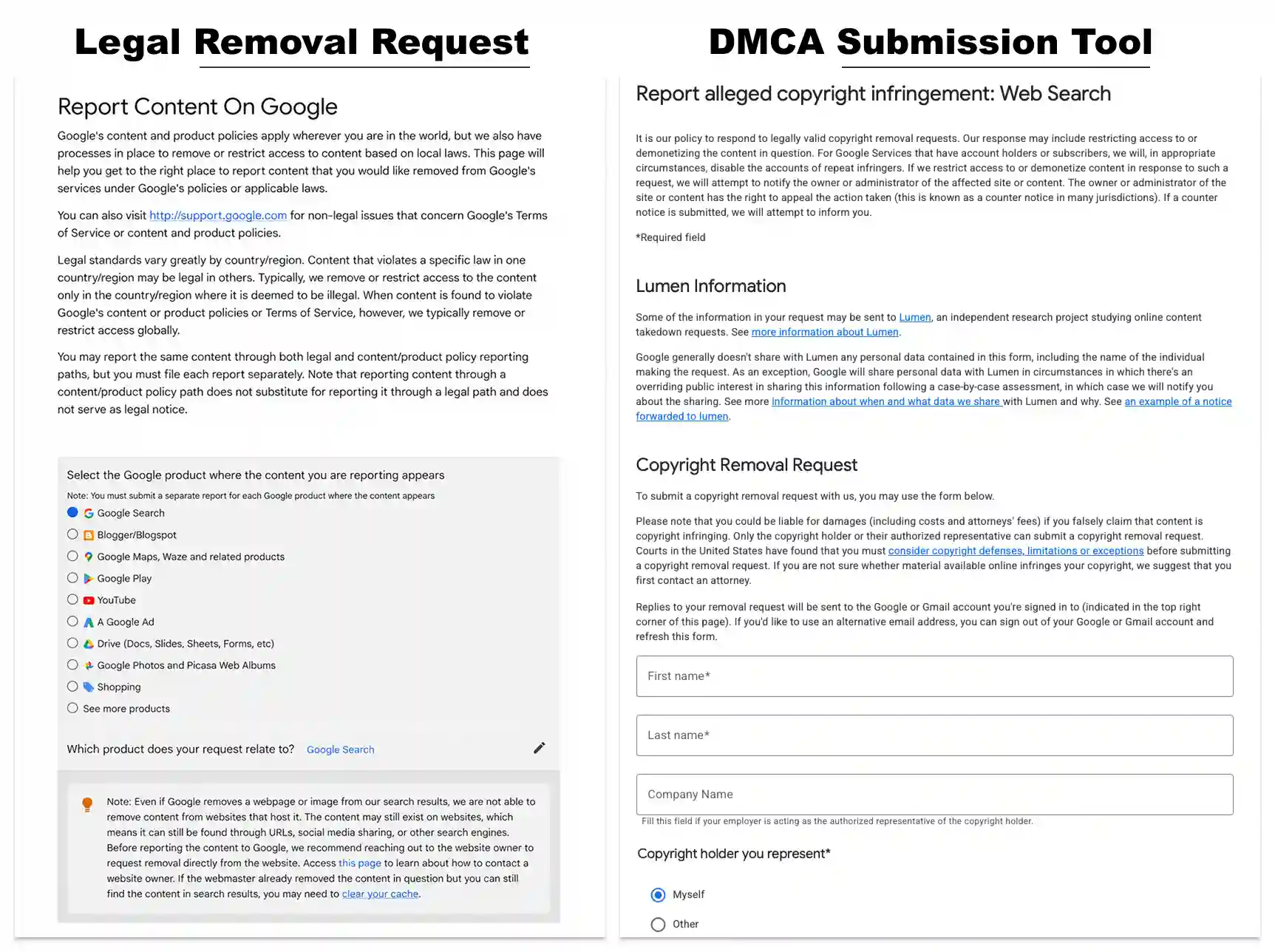
If the content is hosted on an independent website, the notice should be sent to the site’s hosting provider. To identify the host, you can use services such as Who.is or HostingChecker.com. Once you locate the hosting company, look for its designated DMCA agent. U.S.-based online service providers are generally required to register a copyright agent with the United States Copyright Office through the official DMCA Agent Directory.
3. Prepare the DMCA takedown notice
A valid takedown request must include:
-
- Personal details. Name, postal address, email, and phone number.
- Identification of a copyrighted work. Describe the work, include URLs to the original publication and, if applicable, the copyright registration number.
- URLs with the stolen content.
- A statement of good faith belief verifying your sincere conviction that the usage has not been sanctioned.
- A statement of accuracy under penalty of perjury affirming the total accuracy of your claim.
- Your signature.
4. Submit the takedown request
Send your notice to the designated DMCA agent or hosting provider. Many companies accept notices via forms, and smaller hosts may require email submission. We advise sending it as a formal PDF document on letterhead, rather than a plain email, as it tends to receive faster responses.
5. Follow up if needed
After submission, the typical timeframes apply.
- 24–72 hours. Most acknowledge the notice and begin review.
- 7–14 days. Valid notices result in content removal.
- If no action is taken in 14 days, send a follow-up directly to the DMCA agent referencing your original email.
- If no response — escalate or consult a copyright attorney.
- If the content is reposted, file a new notice immediately. Platforms like YouTube are likely to terminate accounts of repeated infringers.
6. Monitor regularly
Stolen content often resurfaces under different URLs after removal. In our practice, we use automated monitoring tools, such as Red Points, Pixsy, and Google Image Search, to track content signatures. Also, to avoid false takedowns, we maintain a “whitelist” of authorized licensees to cross-reference URLs and ensure we only target actual violations.
DMCA notice: step-by-step
- Make a list of URLs with copyright violations
- Identify the host or platforms spreading the content
- Create a DMCA notice
- Submit the request
- Follow up if needed
Professional Copyright Violation Removal Services
Filing a DMCA takedown yourself is entirely possible, and the chances of success are high. However, when infringing content appears across multiple platforms, involves international hosts, or is tied to a broader negative content spreading, it is safer to hire professional reputation management services.
At Reputation America, we have extensive experience in copyright infringement removal and offer it as a part of our comprehensive online reputation management services.
What we do:
- Copyright violation monitoring. We scan the social media platforms and search results for unauthorized use of your content, such as images, text, videos, and more.
- Multiple takedown requests. We issue notices simultaneously across all identified locations, reducing the time during which infringing content remains live.
- Smart escalation. We have established protocols, including registrar complaints and coordination with legal partners, to speed up content takedown in case a hosting provider delays their response to a DMCA notice.
- Search engine deindexing. We file separate deindexing requests with Google, Bing, and other search engines to ensure that no cached version appears in search results.
- Case documentation for legal action. For persistent infringement, we collect evidence and necessary documents for attorneys to support subsequent legal proceedings.
Reasons a DMCA Takedown Request Is Rejected
It is not uncommon for websites or platforms to reject a notice. Let’s walk through the main reasons for negative decisions.
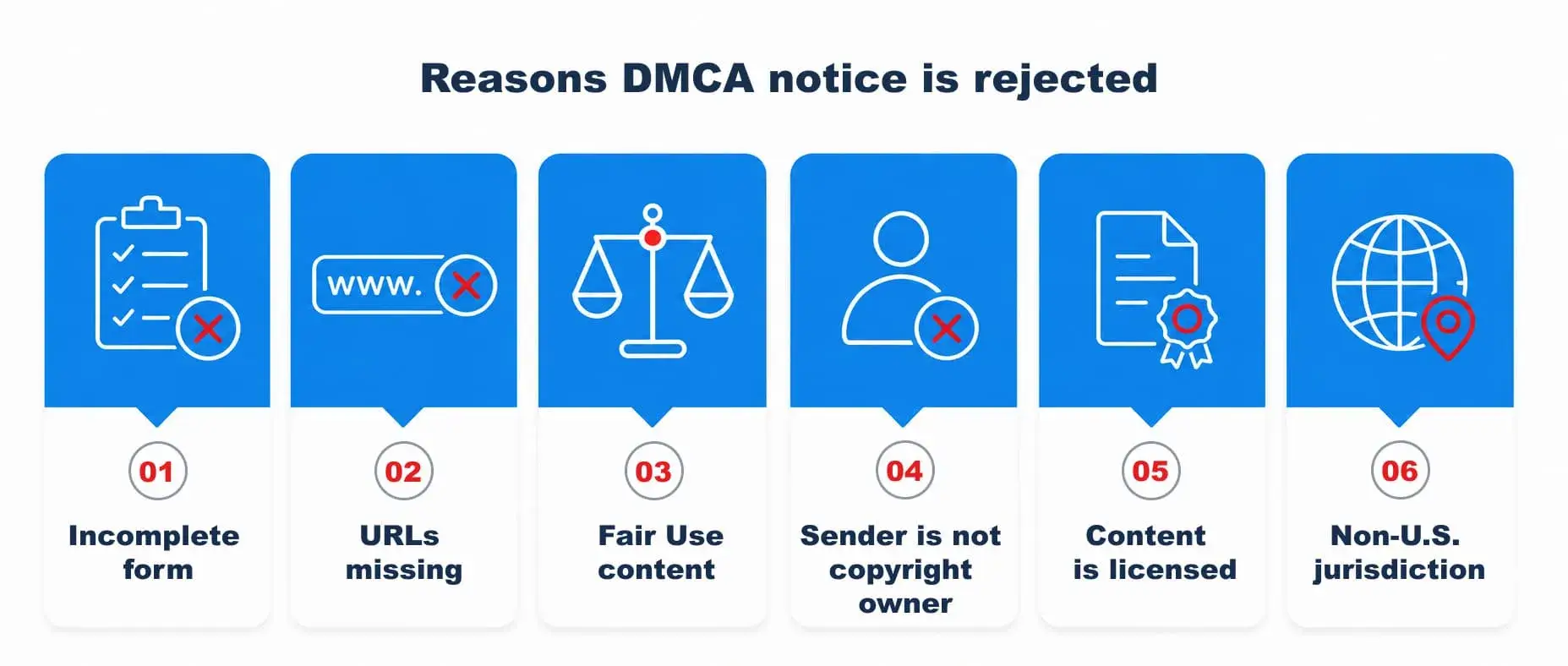
- Incomplete form. If the notice does not include all elements required under 17 U.S.C. § 512(c)(3), including the good faith statement or signature (written or digital), the recipient is legally permitted to ignore it.
- No specific URLs. Describing infringing content is not sufficient for DMCA requests. Provide exact URLs to the content and always double-check that every link is live and accessible before submitting.
- Content falls under the ‘fair use’ category. If it is a commentary, parody, criticism, or transformation, it can be determined that the content you address constitutes fair use.
- Unverified sender’s authority. For example, purchasing stock images does not make the purchaser the copyright owner.
- Content was already licensed. It is also possible that the platform has obtained the necessary licensing, which may be unknown to the notice sender.
- Foreign jurisdiction. DMCA applies to the U.S.-based platforms and providers. If they operate outside the United States and their country does not have applicable international agreements, they have legal grounds to reject the request.
Case study: if a DMCA notice does not work, we escalate the removal request. For example, in webcam cases, we approach the original platform and request that they represent our copyright interests directly, as notifications from the primary rights holder are typically more successful. We also work with non-profit organizations, as their authority helps reinforce the legitimacy of the request and increases the pressure on “gray-area” hosts.
Common triggers for negative decision
- Missing good faith belief or accuracy statement
- No specific URLs provided
- Content qualifies as fair use
- You do not hold the copyrights
- The infringer has a license you are unaware of
- The host is not regulated by U.S. law
What Makes Copyright Violation Removal Difficult
Nevertheless, most DMCA takedowns work, but not every case is straightforward.
Offshore hosting
A significant portion of infringing content is hosted in countries that have no international copyright treaties. In those cases, filing complaints with the domain registrar (many of them are U.S.-based) and requesting Google to delist the content from search results are often the most effective strategies.
Content is partly original and partly infringing
When someone takes your text, rewrites 60% of it, and publishes it as their own, it might not be enough to file a DMCA notice, and the situation may require further legal analysis.
Reputation-motivated infringement
Sometimes the content is stolen to impersonate its creator. These cases often involve fake social media profiles, mirrored websites, or unauthorized use of a brand identity. Such cases may involve defamation and require professional reputation management, reports on impersonation, and even law enforcement involvement. 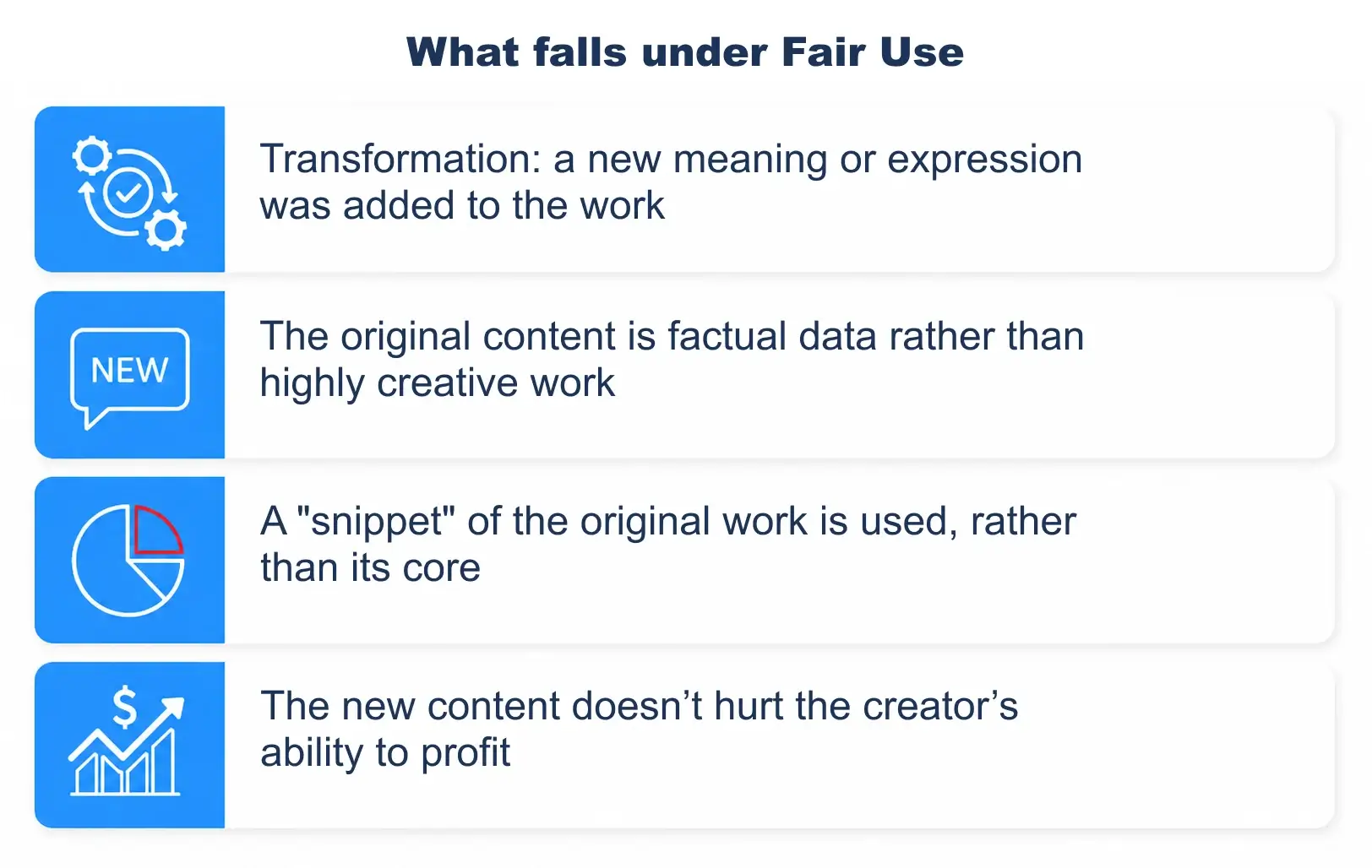
What to do when removal fails
- Complain to a registry company.
- Submit a Google deindexing request to remove the URL from search results.
- Consult a copyright attorney if the host is offshore or non-compliant.
- If infringement happens along with other actions aimed at damaging reputation, consider submitting an impersonation report and taking other legal action.
Copyright Violation and AI
I find it truly fascinating what challenges generative AI has introduced to copyright law. AI systems that generate images or text are trained on enormous collections of online material, often gathered without clear copyright permission.
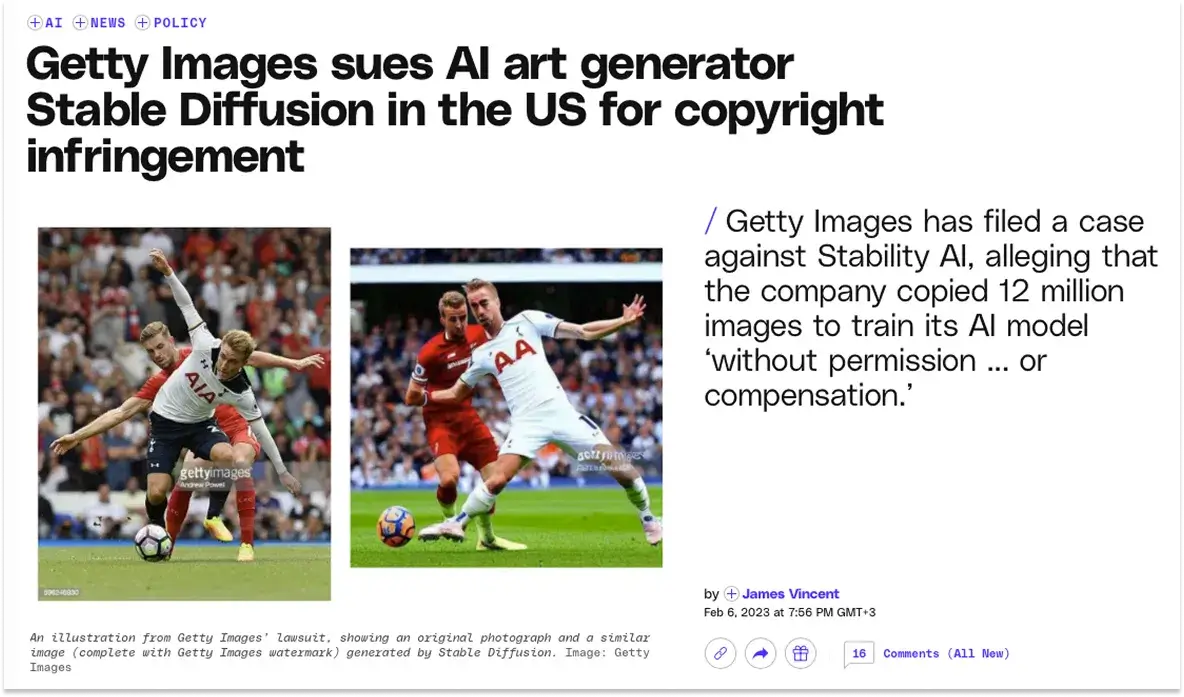
For example, in 2023, Getty Images filed a lawsuit against Stability AI, alleging that it had scrapped 12 millions of copyrighted photographs without a license. Getty claimed that the AI system was trained on these images and used to generate competing imagery. The judicial system has yet to draw a clear line between unlawful replication and a ‘creative inspiration’ by the machines.
From our practice, even after infringing content is removed from Google’s index, AI systems may continue referencing it from cached data or model training sources. In these cases, we directly contact the legal or support teams at OpenAI, Perplexity, and others to request the correction of outputs that cite infringing material. Once the original source is taken offline, we submit cache refresh requests to major search engines, forcing their indexes to update and stop surfacing removed links.
Key highlights
- AI training datasets frequently include copyrighted works scraped without consent.
- Currently, there is no fully effective legal mechanism to demand the removal of copyrighted work from an AI training dataset.
- Currently, copyright registration, metadata, and opt-outs are your best available tools.
FAQ
Copyright infringement happens when someone uses copyrighted work without permission from the copyright owner. This can include images, music, videos, articles, code, and even some forms of copyrighted AI output if it reproduces the original too closely.
Filing a basic takedown is completely free. You can submit a request directly to a website's hosting provider or platform agent to remove copyrighted content. However, if you need to remove stolen content at scale or have a complex case, you may choose to hire professional copyright infringement removal services.
If "fair use" or ownership is claimed via a DMCA counter-notice, the platform may automatically restore the infringing content within 10–14 days. Prevent this by providing evidence, including licensing agreements, raw file metadata, and publication history and requesting manual review by the platform’s legal team rather than an automated system. Also, be prepared to file a lawsuit.
Suing for copyright infringement can be worth it if the stolen content causes financial loss, harms reputation, or impedes business operations. Frequently, the most rapid and economical strategy involves deploying a statutory takedown notification to eliminate the content. Nevertheless, legal action may be necessary when copyrighted material is exploited commercially or surfaces online even after multiple removal attempts.
List of sources
- Primary Sources On Copyright, Stowe v. Thomas, Pennsylvania (1853)
- U.S. Chamber of Commerce, Impacts of Digital Piracy on the U.S. Economy
- CBS News, Peloton sued for allegedly stealing artists' music
- APA, Donald Graham Opens Up About Richard Prince Copyright Infringement
- Latham & Walkins, Getty Images v. Stability AI: English High Court Rejects Secondary Copyright Claim






This article does not have any comments. Be first to leave one.